@random_walker
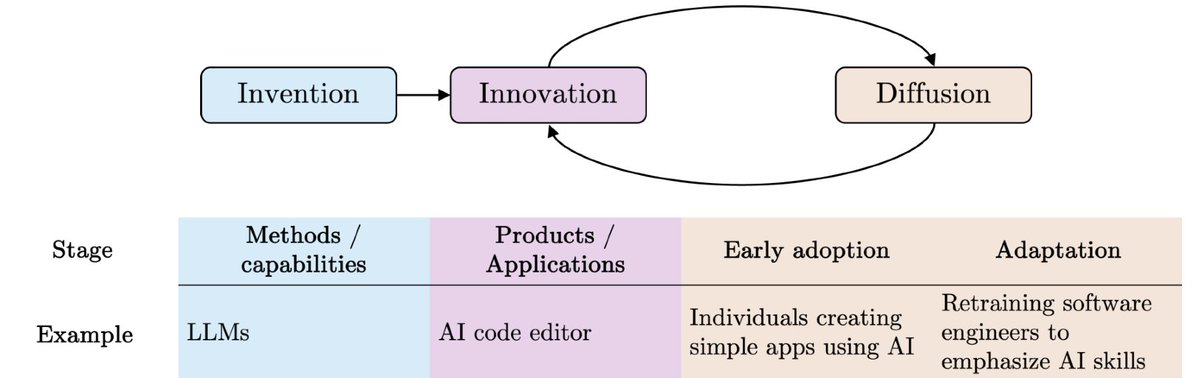
Is the rise of coding agents surprising or consistent with our predictions? Thanks for the question, @_NathanCalvin. https://t.co/fLdWDgSRAL The answer is: Both surprising and consistent. AI as Normal Technology (AINT) doesn't give us a way to predict the timing of specific capability advances, and we haven't tried to do that. But when it comes to understanding why coding agents work so well and what their impacts are likely to be, AINT is extremely helpful (and its predictions are consistent with what we observe so far). 1. Products, not just models. One key prediction is that model capability advances are generally not useful by themselves; building products is still necessary in order to meet people where they are, instead of forcing people to contort their workflows to fit the affordances of raw LLMs. That's exactly what we see with Claude Code and other agents. If we try to understand the success of coding agents as the result of model capability leaps, it doesn't make sense. Rather, coding agents have dozens if not hundreds of features, both big (like memory) and small (like rewinding or interruptability) that allow software engineers to integrate them into workflows. 2. Early adoption. Despite everything we hear on X, we're still in the early adoption phase. The median programmer (keep in mind that they work in a regulated industry like finance or healthcare) has barely heard of coding agents and is not yet using them in any serious way. 3. The speed of diffusion. As I've written before, the software industry has uniquely low diffusion barriers and programmers have a long history of embracing productivity improvements to continually migrate up the abstraction chain (machine code -> assembly -> compiled languages -> high-level languages -> frameworks -> AI-assisted programming). Because of this, software has "has never had time or the cultural inclination to ossify institutional processes around particular ways of doing things." I highly doubt that we are going to see the same speed of diffusion in other sectors. For example, see our analysis of AI in legal services here https://t.co/0kYIaT2UJJ 4. Labor market impacts. AINT predicted that in most cognitive jobs the result of AI adoption won't be replacing humans but shifting the role of humans to supervising AI systems. Of course we were hardly alone in making that prediction but it's good to see that this is what is happening in software. There's also the fact that in most white-collar jobs, if it gets cheaper to produce a unit of work, we will simply produce more of it — orders of magnitude more in the case of software (related to "Jevons paradox"). This is another factor that mitigates job loss risks.