@Dan_Jeffries1
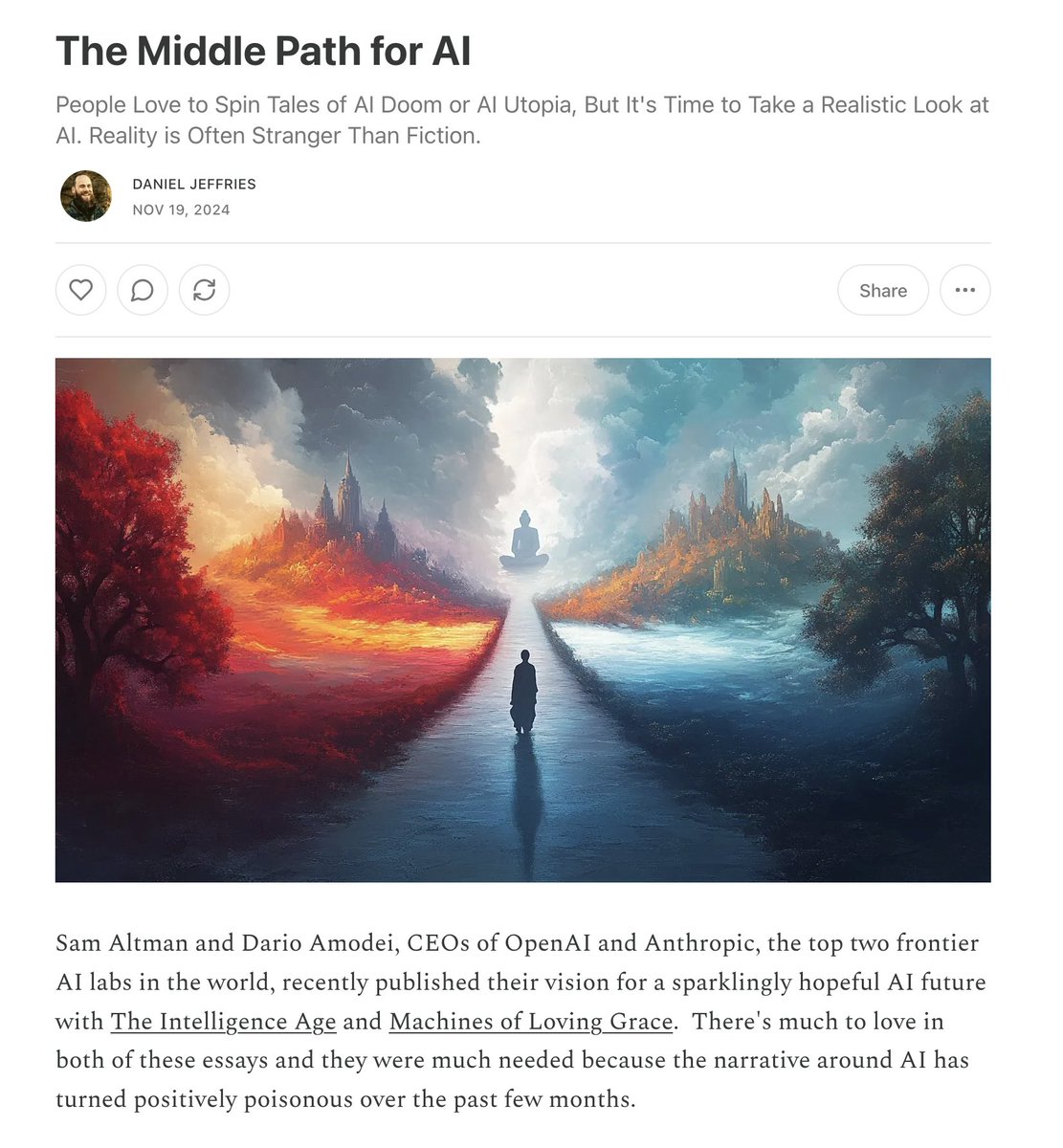
In my latest article I paint a hopeful but realistic view of the future, threading the needle between the screaming headlines of AI utopia or AI doom. We don't need more doom or utopian visions. What we most desperately need is a heavy dose of realism. We need the middle path of AI. Unfortunately, nuance and reality don't sell very well. You win more friends, money and social media followers screaming extreme ideas about heaven and hell. We're all going to going to live forever, dancing into the sunlight in a bold new age, and they'll be no more disease and no more suffering and no more pain! Or, if we don't act right now we're all going to dieeeeeeeeeeeeeee! To get a realistic picture of AI we need to concentrate on seeing through the fog and the noise. The Utopian future fantasies of the Culture sci-fi series cited by Amodei, versus the runaway, recursive AI self-improvement of Yudowski, aka AI FOOM, are binary, visions that make for great stories but they're not a great reflection of actual reality. If we're always focused on heaven or hell, we have no hope of getting any kind of clear picture of how AI will actually impact life, work and the world. Even worse, we have no hope of building useful legal frameworks or strong guardrails and of letting regular folks just go about their business without jumping through useless hoops because we've shackled all these systems with a suffocating bureaucracy. Here's the truth: No matter what we do, AI will do good and bad things. Let's be even more clear: We will not stop all the bad uses of AI and guarantee that AI only gets used for good. That's impossible. No matter what policies we set, no matter what kind of government we choose, life always has positives and negatives. There is no society in history, ever, and there never will be, that is all positive or all negative. That is for children's books and great, door stopper fantasy epics. Instead it's best to look at societies and cultures on a continuum of light to dark at the same time. The question we have to ask is: Does a society, on the whole, produce more positive outcomes and lives for its people or more negative ones? To understand how to get more of the good things and less of the bad things, we have to see clearly. We have to set aside Heaven and Hell and focus on the more likely parts of the probability distribution of the future so we can make practical plans and shepherd ourselves into a better tomorrow. So what does a realistic picture of the future look like? Read on to see. (Article link in the comments, because X.)