@omarsar0
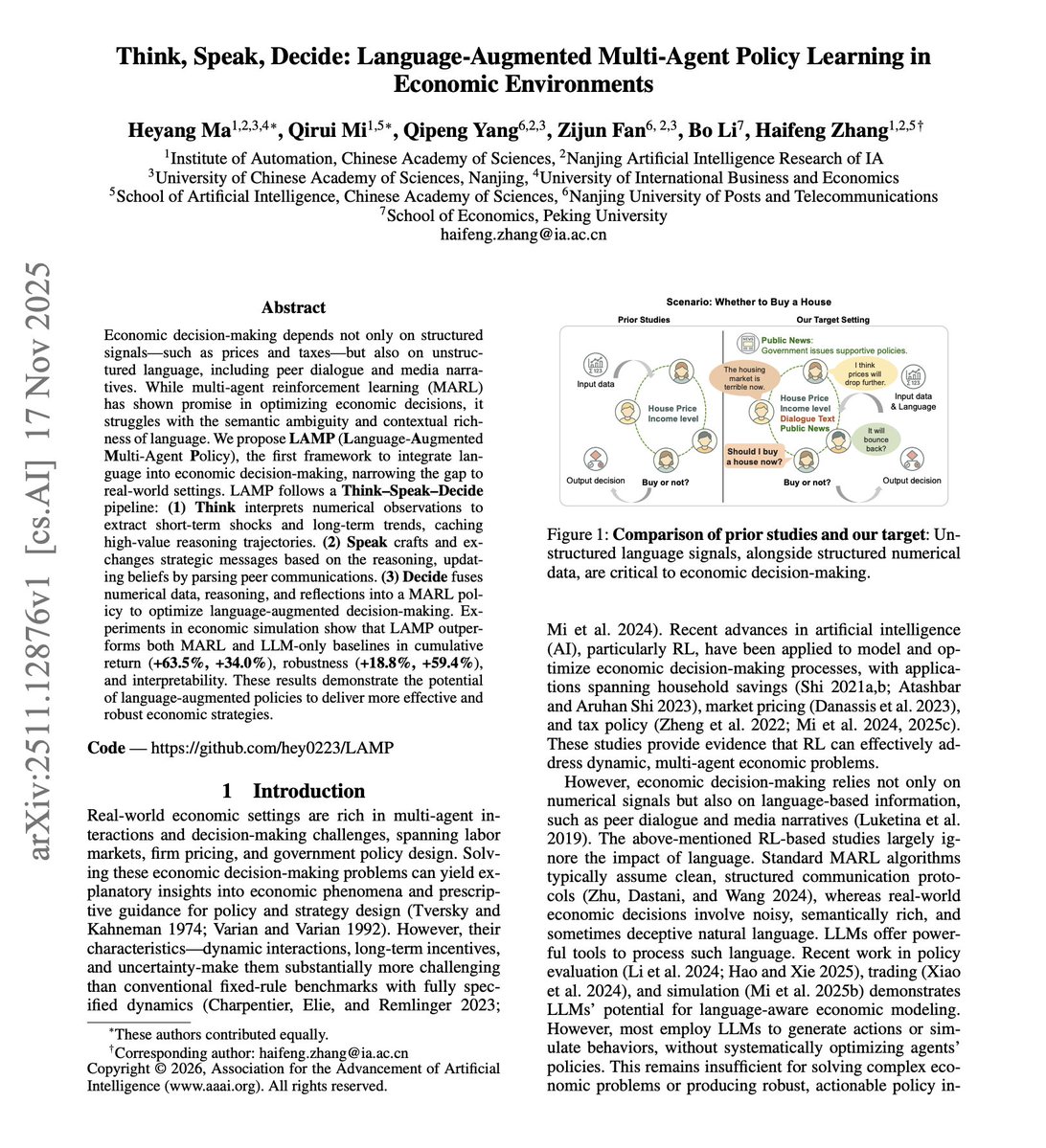
Multi-agent systems struggle with coordination. Not because agents can't learn. It's because they can't communicate what they're thinking. Traditional MARL relies on implicit coordination. Agents learn through behavior. Through trial and error. Through observing each other's actions. But economic decisions require negotiation, strategy articulation, and explicit reasoning. Humans don't just act. We think, speak, and make decisions. This new research paper introduces a framework where agents do the same. Language-augmented multi-agent reinforcement learning for economic decision-making. The key innovation: language isn't just explanation. It's a functional coordination mechanism. This framework embeds communication as a core component of the learning process. Agents use natural language during learning and decision-making. They articulate strategies. They negotiate outcomes. They reason explicitly about economic choices. Not after the fact. This happens during the process. Here are the applications these agents unlock: - Autonomous market systems - Trading strategies - Resource allocation - Negotiation-based problem solving. What makes this powerful: agent behavior becomes interpretable and auditable. You can see what they're thinking, understand their reasoning, and trust their decisions. This shows great potential of agents that genuinely negotiate, not just implicitly coordinate. (bookmark it) Paper: arxiv. org/pdf/2511.12876