@dair_ai
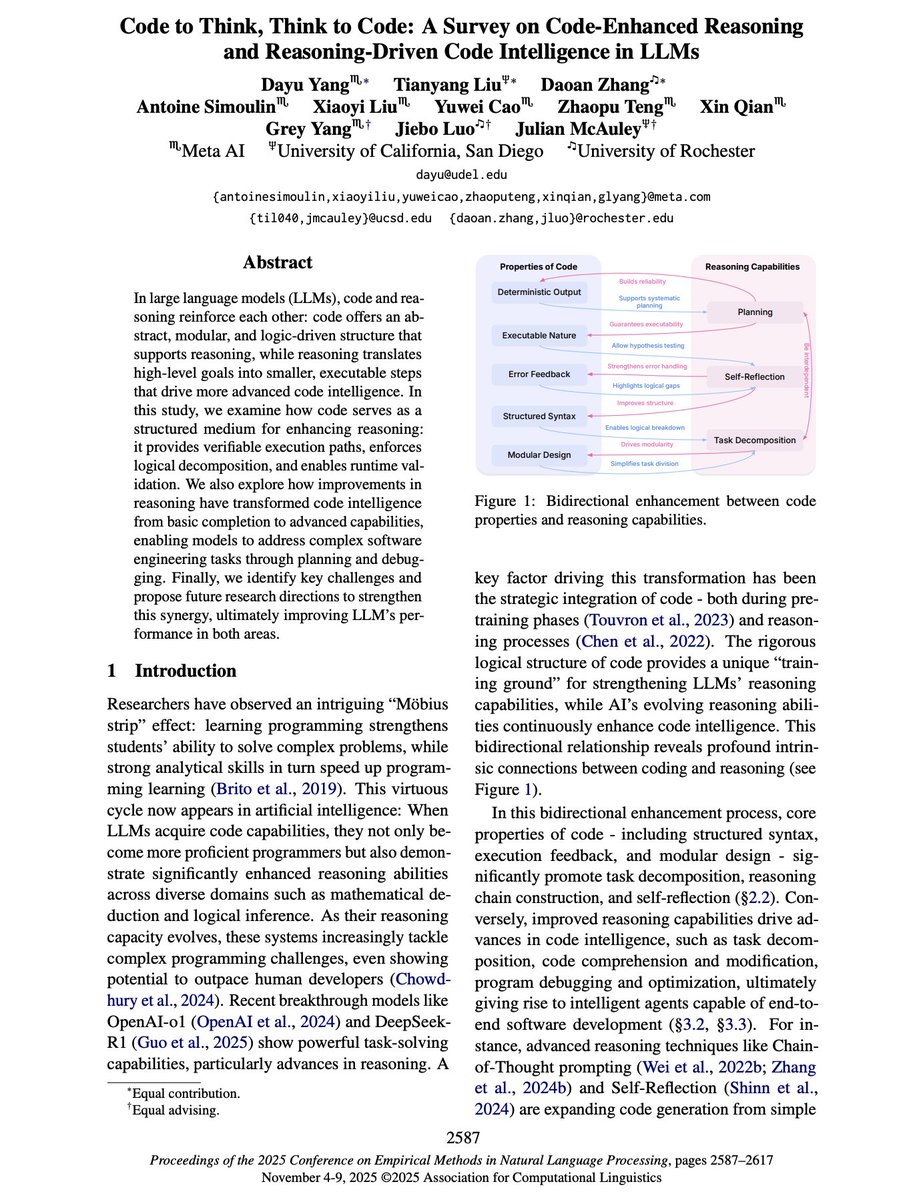
Code isn't just what LLMs produce. It's also useful for reasoning. The relationship between code and reasoning in LLMs runs deeper than it seems. It's not just about generating Python scripts. It's bidirectional: code enhances reasoning, and reasoning transforms code intelligence. This new survey paper, "Code to Think, Think to Code," maps this two-way street across the research landscape. In one direction: code strengthens reasoning. Code is abstract, modular, highly structured, and has strong logic. When LLMs use code as a reasoning medium, they gain verifiable execution paths, logical decomposition, and runtime validation. The structure of code becomes scaffolding for thought. In the other direction: reasoning elevates code intelligence. Basic code completion was just the beginning. With deliberate reasoning capabilities, LLMs evolve into agents that plan, debug, and solve complex software engineering problems. From autocomplete to autonomous engineer. The survey synthesizes research across both directions, identifying key patterns: how structured code provides verifiable reasoning pathways, and how reasoning transforms simple code generation into sophisticated agent-based systems. Understanding this bidirectional relationship is essential for building more capable AI systems. Code and reasoning aren't separate tracks. They reinforce each other. The future of LLM capability lies at its intersection. 🔖 (bookmark it) Paper: https://t.co/Ba8cbUOEYl Learn to build AI agents in our academy: https://t.co/zQXQt0PMbG