@dair_ai
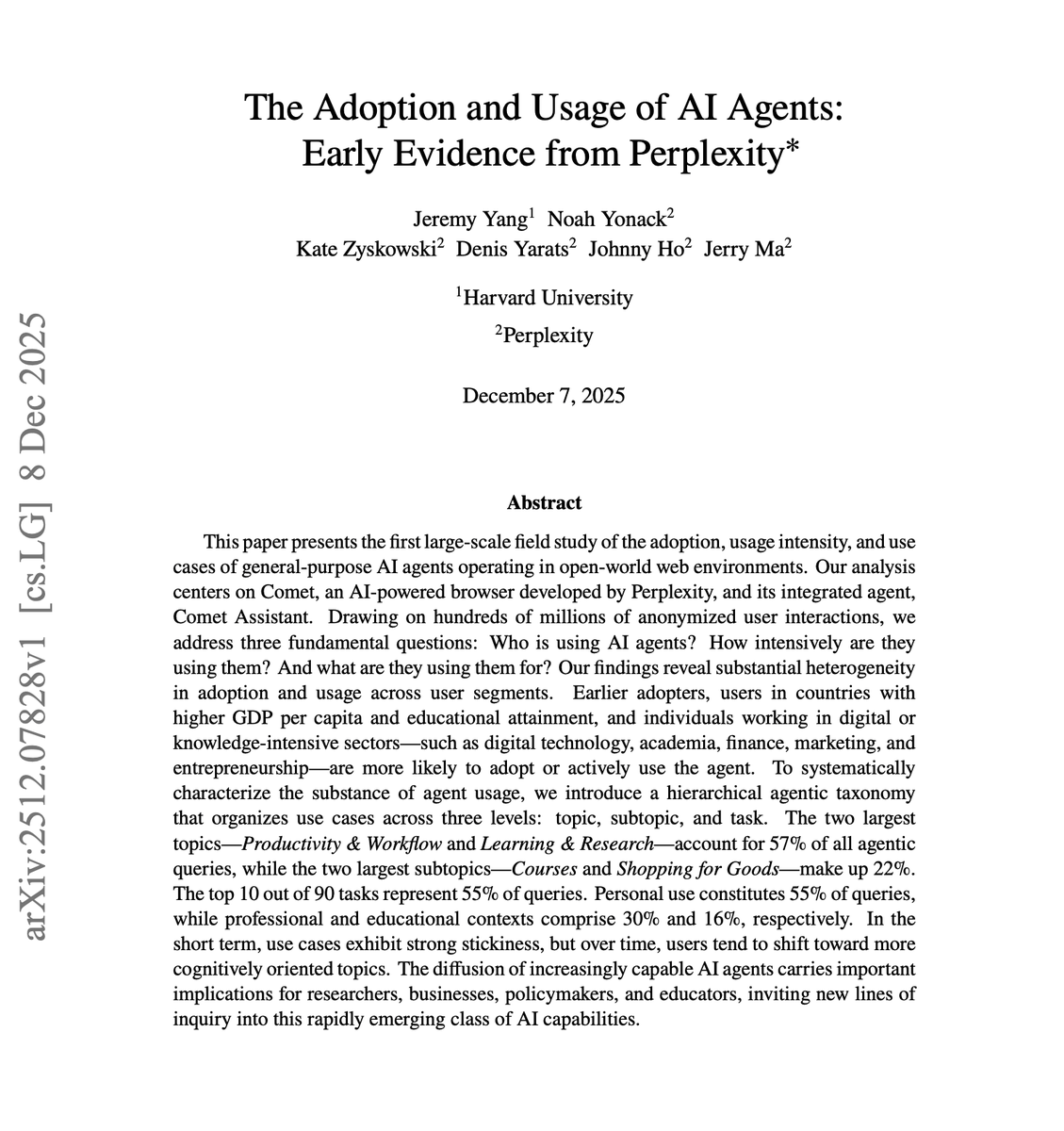
First large-scale field study of how people actually use AI agents in the wild. The hype says 2025 is the year of agentic AI. But systematic behavioral evidence on real-world agent adoption has been almost nonexistent until now. Researchers from Harvard and Perplexity analyzed hundreds of millions of anonymized user interactions with Comet, Perplexity's AI-powered browser with an integrated agent. They examined three fundamental questions: Who adopts AI agents? How intensively do they use them? And what for? The patterns reveal a stark adoption divide. Early adopters drive disproportionate usage. Users in the first access cohort (July 9) are twice as likely to adopt the agent and make nine times as many agentic queries as users who joined at general availability. The post-GA period accounts for 60% of agent adopters but only 50% of agentic queries. Country-level analysis shows strong correlations. Agent adoption per capita correlates with GDP per capita (r = 0.85) and average years of education (r = 0.75). "Relatively more economically developed and educated countries tend to adopt and use the agent more." By occupation, digital technology workers dominate: 28% of adopters and 30% of all agentic queries. Academia, finance, marketing, and entrepreneurship follow. Together, these knowledge-intensive sectors account for over 70% of total adopters and queries. Workers in marketing show the highest usage intensity relative to their user base (AUR = 1.46), followed by entrepreneurship (1.38) and students (1.26). What are people actually doing with agents? Productivity and Learning together represent 57% of all agentic queries. The top two subtopics, courses (13%) and goods shopping (9%), account for 22%. The top 10 out of 90 identified tasks represent 55% of all queries. The single most common task? Exercise assistance for courses at 9.4%, followed by summarizing research information (6.7%) and creating/editing documents (6.6%). Usage context breaks down to 55% personal, 30% professional, and 16% educational. For professional use, 80% of queries are productivity and career-related. Educational usage is dominated by learning at 89%. The top environments reveal where agents actually operate: Google Docs (12%), email services (11%), LinkedIn (9%), YouTube (7%), and Amazon (3%). Environment concentration varies dramatically: LinkedIn accounts for 93% of professional networking queries, while account management queries spread across many sites, with the top five covering only 28%. Use cases show strong stickiness. Users making consecutive queries tend to stay within the same topic. When they do transition, they most likely move toward productivity, learning, or media topics. Over time, query shares shift from travel and media toward more cognitively oriented categories like productivity, learning, and career. This is the first empirical baseline for understanding real-world AI agent adoption. The data reveals a clear pattern: knowledge workers in wealthy, educated countries are pulling ahead in agent usage, with specific occupations like marketing, entrepreneurship, and digital technology leading adoption intensity. Paper: https://t.co/L5UFjmRNTE Learn to work with AI Agents in our academy: https://t.co/zQXQt0PMbG