@dair_ai
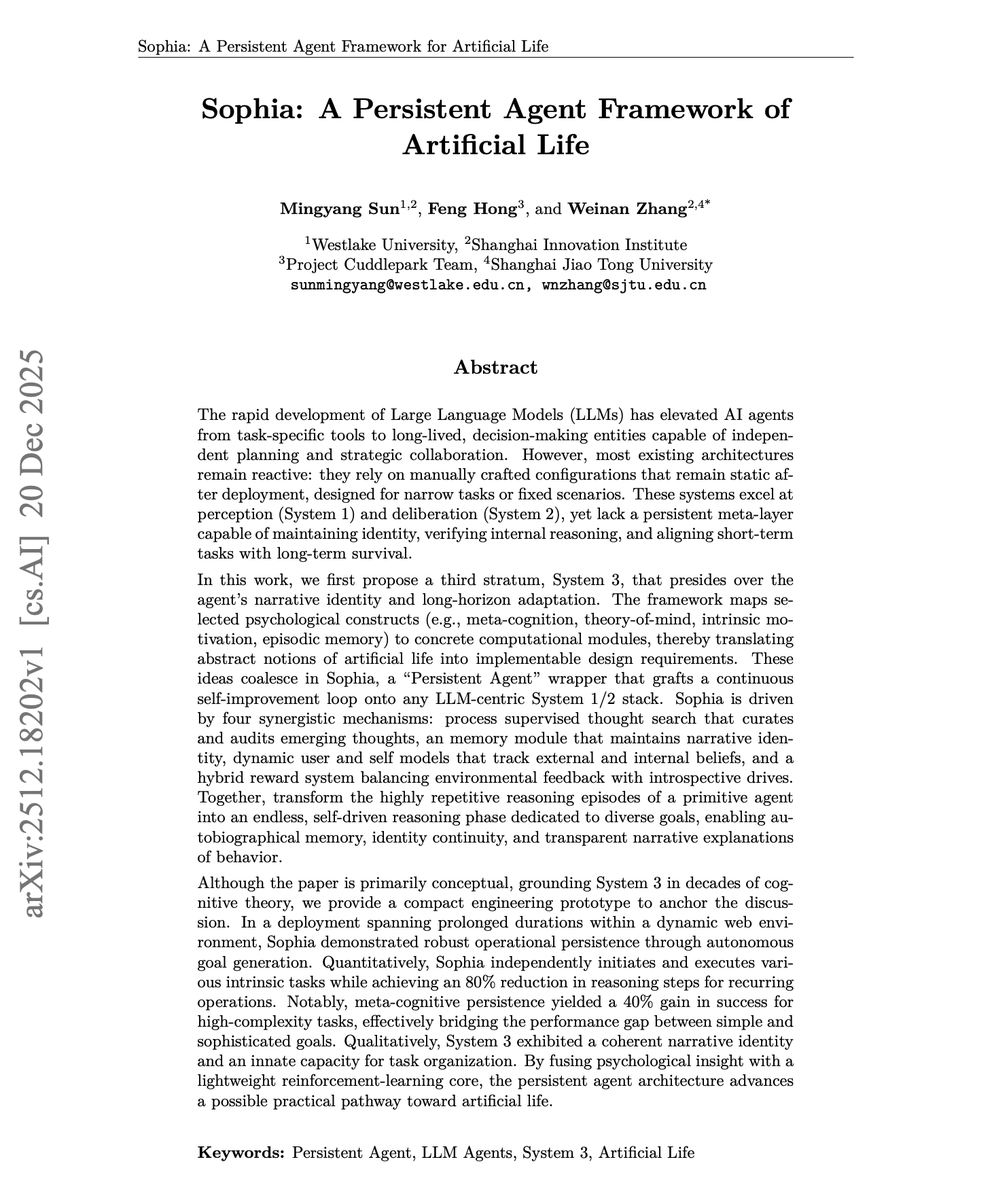
This paper is worth reading carefully. It introduces System 3 for AI Agents. The default approach to LLM agents today relies on System 1 for fast perception and System 2 for deliberate reasoning. But they remain static after deployment. No self-improvement. No identity continuity. No intrinsic motivation to learn beyond assigned tasks. This new research introduces Sophia, a persistent agent framework built on a proposed System 3: a meta-cognitive layer that maintains narrative identity, generates its own goals, and enables lifelong adaptation. Artificial life requires four psychological foundations mapped to computational modules: - Meta-cognition monitors and audits ongoing reasoning. - Theory-of-mind models users' beliefs and intentions. - Intrinsic motivation drives curiosity-based exploration. - Episodic memory maintains autobiographical context across sessions. Here is how it works: > Process-Supervised Thought Search captures and validates reasoning traces. > A Memory Module maintains a structured graph of goals and experiences. > Self and User Models track capabilities and beliefs. > A Hybrid Reward Module blends external task feedback with intrinsic signals like curiosity and mastery. In a 36-hour continuous deployment, Sophia demonstrated persistent autonomy. During user idle periods, the agent shifted entirely to self-generated tasks. Success rate on hard tasks jumped from 20% to 60% through autonomous self-improvement. Reasoning steps for recurring problems dropped 80% through episodic memory retrieval. This moves agents from transient problem-solvers to adaptive entities with coherent identity, transparent introspection, and open-ended competency growth. Paper: https://t.co/Eyy7mI9P1i Learn to build effective AI agents in our academy: https://t.co/zQXQt0PMbG