@random_walker
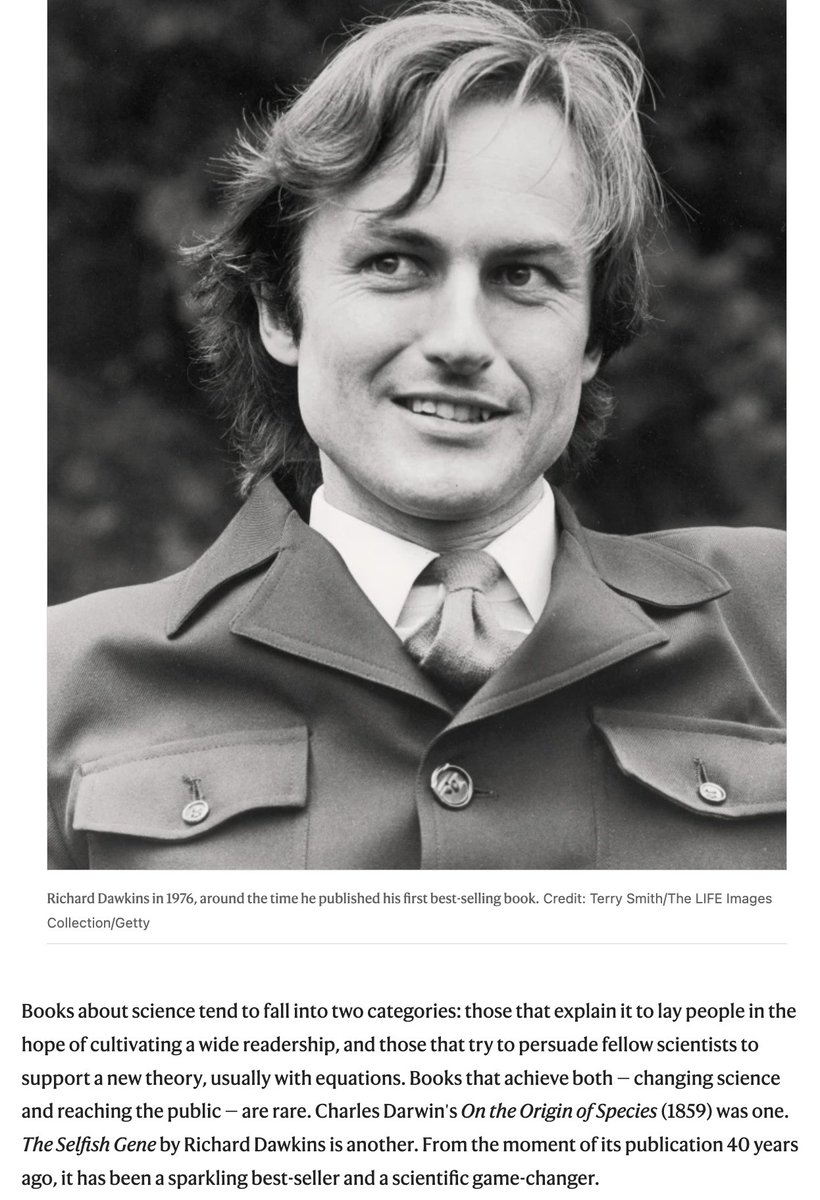
This is the story of how reading “The Selfish Gene” when I was around 15 changed my career decades later. It’s a terrific book. But beyond its substance, it changed my view of what science can be. It showed me that there are simple but profound ideas waiting to be discovered. I’d thought of the frontier of science as necessarily esoteric, but the book proved otherwise. Richard Dawkins’s writing also showed me that it’s possible to explain novel and profound ideas in a way that even a child (me) could understand them. When I grew up and became a researcher, I never stopped thinking about this. I began to gravitate toward the simplest questions within my areas of expertise, rather than the hardest, contrary to the norm in science. And I taught myself how to communicate my ideas to as broad an audience as possible. Unfortunately, the peer review process heavily penalizes this approach, because the value system prioritizes abstruseness, when ideally it should be the opposite. But no matter — I found that simpler ideas, when they do get published, are much more widely read, which made it all worthwhile. Besides, pushing to make ideas as simple and as simply communicated as possible often made them *better ideas*, more robust and widely applicable than initially anticipated. Aspirations should be balanced with an awareness of one’s limitations. Not everyone can be as successful as Dawkins; I realized that I couldn’t count on my ideas being so powerful that they would spread on their own (fittingly, the term “meme” was coined in The Selfish Gene!) So I’ve tried to put as much effort into spreading ideas as I do into generating and explaining them. That’s a topic I’ve written about here before and probably will again.