@JacksonAtkinsX
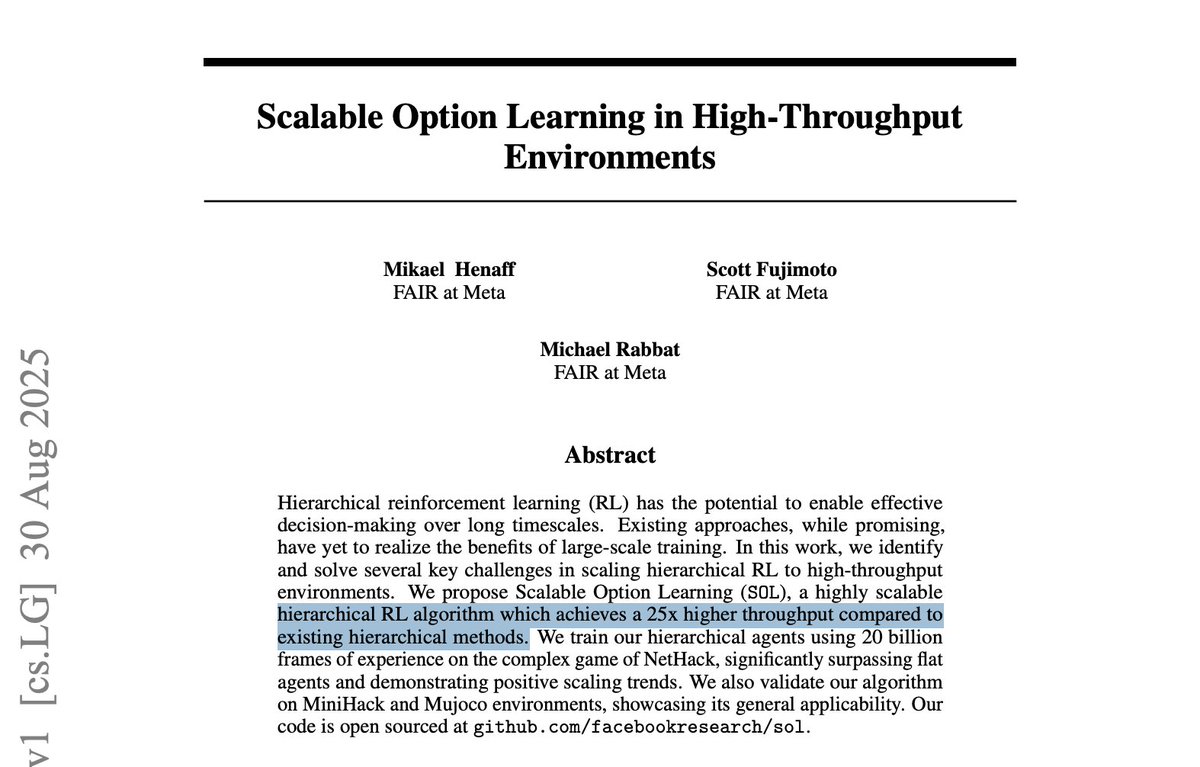
Meta just made training AI agents 25x faster. This is a breakthrough for robotics and complex planning. Meta's FAIR open sourced a new method called Scalable Option Learning. It trains a specialized agent at the scale previously seen only with LLMs. Here's how it works: The reason this type of AI (Agents trained with Hierarchical Reinforcement Learning) has been slow to train is a parallelization bottleneck. Imagine an AI team with a planner and many specialist workers (the sub-tasks). Older methods struggled because they had to process each planner's decision one-by-one before training the workers. SOL solves this with a new system design: A Single, Unified Brain: Instead of separate models, it uses a single actor-critic network to house the planner (controller policy) and all the workers (option policies). A Digital "Switch": It tells this unified brain which role to play at any given moment using a one-hot vector, a flag that says, "for this input, act as the 'navigation' worker." This allows thousands of different decisions for different policies to be batched and sent to the GPU at once. A Smart "Filter" for Learning: After the actions are taken, it uses a technique called tensorized masking. Think of this as a smart filter that ensures the right performance feedback (the rewards and advantages) goes to the correct worker policy. This is what breaks the one-at-a-time update problem. This architecture allows the entire hierarchical system to learn in parallel batches and removes the bottlenecks that held the field back. Why this matters: This new training method changes the viability of building agents that can reason and execute long-horizon tasks. - Business Leaders: This architecture is a key to developing sophisticated autonomous systems. A 25x faster training cycle accelerates R&D in robotics, logistics, and multi-stage process automation, making complex, strategic AI commercially achievable. - Practitioners: The authors plan to open-source SOL. You can implement agents that learn long-horizon skills without the performance penalty of older HRL methods, creating a path to more structured and potentially more robust models. - Researchers: This paper presents a validated solution to the HRL scaling problem (Section 3.2). The system for enabling high-throughput, asynchronous updates for a hierarchical agent is a major contribution that opens the door for large-scale experiments in temporal abstraction and credit assignment.