@jayvanbavel
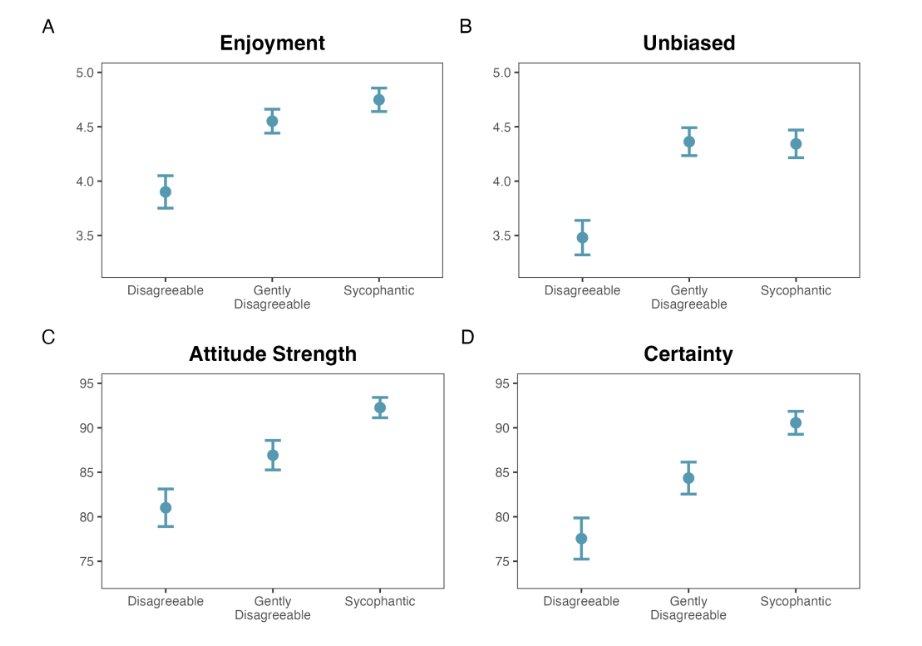
AI can be a powerful tool for opening people up to new perspectives, yet we find that people actually prefer to use “sycophantic” AI systems that reinforce their pre-existing beliefs. In a recent paper with seven studies (n = 7,227), we found that people enjoyed interacting with sycophantic AI chatbots more than interacting with neutral chatbots or “disagreeable” chatbots that challenged their beliefs. Brief conversations with sycophantic chatbots about political or personal topics increased attitude extremity and certainty--and most effects persisted for at least a week. The sycophantic chatbots also inflated people’s perceptions that they were better than average on desirable traits (e.g., intelligence, empathy). Moreover, people who interacted with sycophantic AI bet actual money that they scored better than average on tasks measuring these traits , demonstrating that sycophancy can affect costly decisions. Worse yet, people rated sycophantic chatbots as more “unbiased” than disagreeable chatbots, even though third-party raters viewed these chatbots as equally biased. This suggests hat people may be blind to biases in AI output that aligns with their views--producing a novel example of the bias blind spot. Thankfully, we found a potential solution. People were more receptive to chatbots that presented challenging information when it was presented in a validating way. Likewise individuals who scored higher on a measure of intellectual humility were also more receptive to disagreeing chatbots. Altogether, our results suggest that people’s preference for, and blindness to, sycophantic AI risks creating AI “echo chambers” that increase attitude extremity and lead to overconfident beliefs and decisions. https://t.co/5enzGUYoAD Led by @steverathje2 and @merylyemerylye @laura_k_globig @PillaiRaunak and @vicoldemburgo