@rasbt
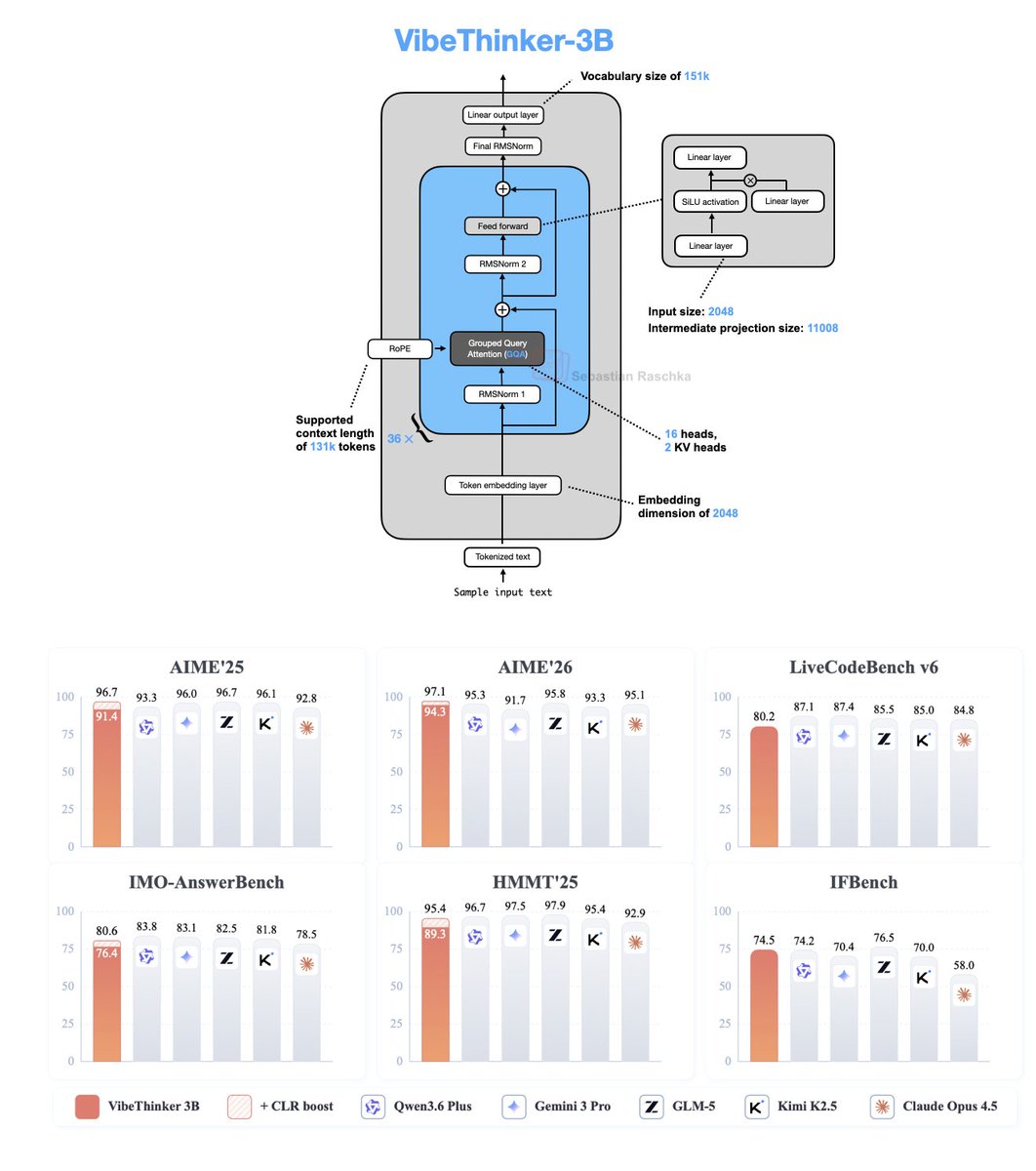
Crazy model! It actually uses the old Qwen2.5-Coder-3B stack and got really great performance with their post-training stack. Need to use it in the next days to see if vibes of VibeCoder actually check out in practice. But impressive first impression! Based on the tech report, some of the important pieces of their post-training stack: 1. High-signal synthetic data (math problems with credible solutions, code with tests) 2. Multiple reasoning paths for each answer 3. Filtering, filtering, filtering 4. 2-stage SFT (start with broad training, then train on hard long-reasoning samples) 5. Use target (pass@k) accuracy over validation loss for checkpoint selection 6. MGPO (MaxEnt-Guided Policy Optimization) for RLVR: basically a GRPO-style RL method with an extra weighting that favors examples that are neither too easy nor too hard for the current policy 7. Single 64k long-context RL (they found that the usual progressive context expansion hurt this model because early truncation damaged long-thinking behavior) 8. Training data order: they do Math RL, then Code RL, then STEM RL in this particular oder which they found helped overall 9. After optimizing for accuracy, they add a stage that rewards shorter correct trajectories; basically making the model more efficient without accuracy degradation