@tokens
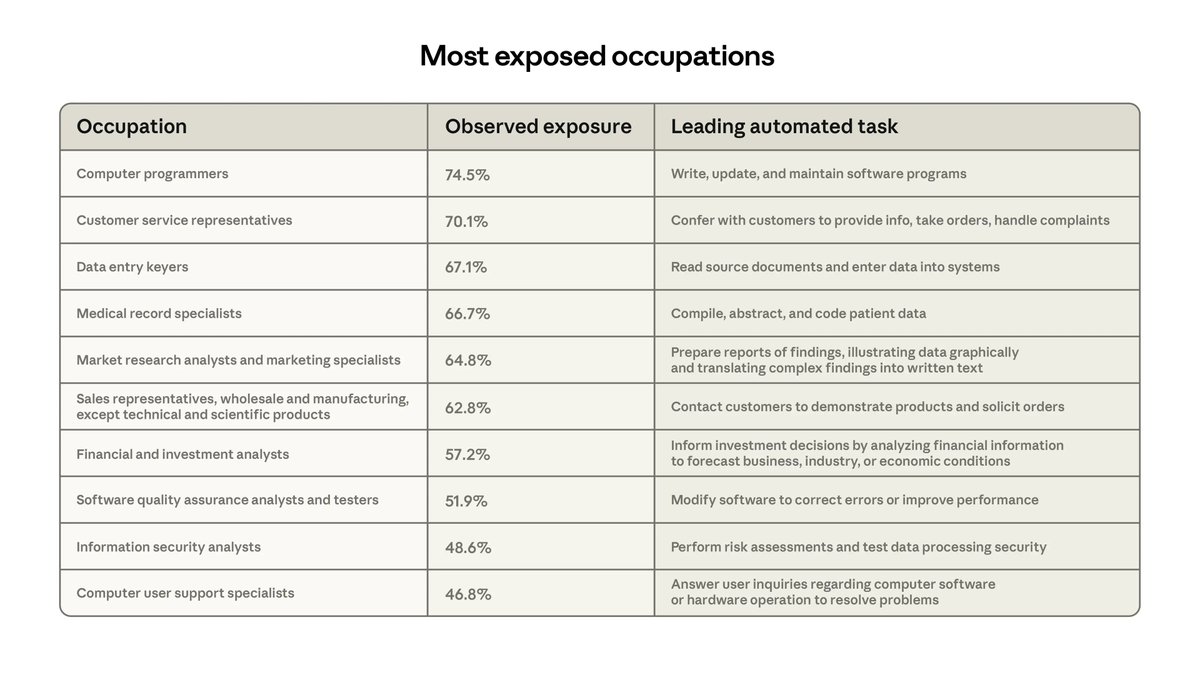
BREAKING: @Anthropic just published research on which jobs its own AI is disrupting. The company used Claude's actual usage data to measure real-world displacement risk across 800 U.S. occupations. Here's what the data shows. The top 10 most exposed occupations: 1. Computer Programmers (75% of tasks covered by AI) 2. Customer Service Representatives 3. Data Entry Keyers (67%) 4. Editors 5. Administrative Assistants 6. Accountants 7. Technical Writers 8. Paralegals 9. Market Research Analysts 10. Web Developers The workers most at risk are not who you'd expect. The most exposed group earns 47% more than the least exposed. They are 16 percentage points more likely to be female, significantly more likely to hold a graduate degree, and tend to be older. This is not a blue-collar disruption. It's a white-collar one. AI is still far from reaching its theoretical ceiling. In Computer and Math occupations, 94% of tasks are theoretically automatable by an LLM. Only 33% are actually being automated. The gap between what AI can do and what it is doing is enormous, and it is closing. 30% of U.S. workers have zero AI exposure. Their jobs don't appear in Claude's usage data at all. This includes cooks, motorcycle mechanics, lifeguards, bartenders, and dishwashers. Physical work remains untouched. The most striking finding: there is no systematic increase in unemployment for highly exposed workers since ChatGPT launched. Not yet. But hiring of younger workers in exposed occupations has slowed. Companies are not firing. They are simply not replacing. For every 10 percentage point increase in AI task coverage, the Bureau of Labor Statistics projects job growth drops by 0.6 percentage points through 2034. The BLS is already baking AI displacement into its forecasts. Anthropic says it plans to revisit this analysis regularly. The company is building the framework now, before mass displacement becomes visible, so that when it does, the data is already in place. This is the first time a major AI lab has published granular, usage-based evidence of which jobs its own technology is replacing.