@omarsar0
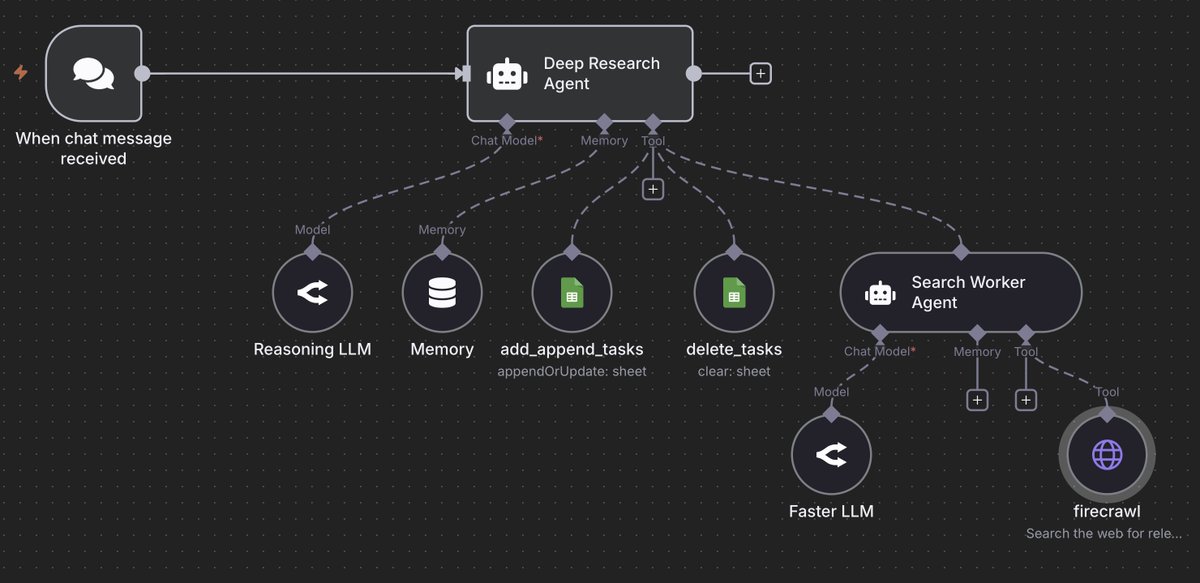
If you are not building with AI subagents yet, I don't know what you are waiting for. It doesn't matter what you are using and what you are building. It could be Claude Code, LangGraph, or n8n. Subagents significantly improve results across all kinds of tasks. In the n8n example I show in the figure, having a search tool connected directly to the Deep Research Agent can be significantly improved by simply moving the search tool to its own subagent worker. It works great because of the separation of concerns, and it mitigates context confusion. The best part is that you get the benefit of using fast and smaller models with subagents. As we add complexity to this workflow, the benefits compound. Easier to debug, enable agent-to-agent communication, optimize, maintain, and evaluate. One not-so-obvious benefit of building with modular architectures like this is that you can generalize this system a lot more easily. For example, I can simply convert this workflow to a general agentic orchestrator like Claude Code. Build with subagents in mind. Thank me later.