@omarsar0
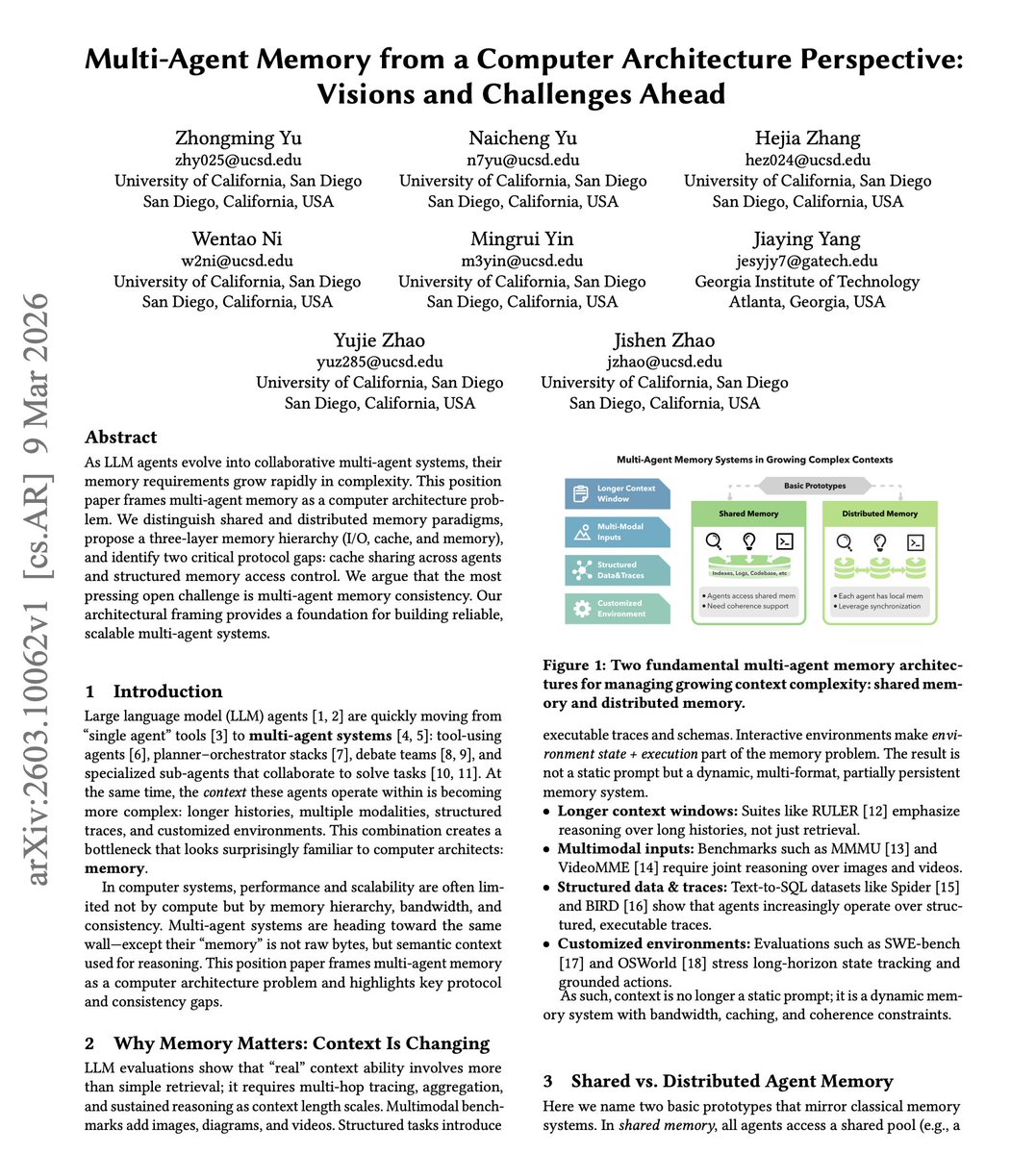
Memory is truly a game-changer for AI agents. Once I had memory set up correctly for my proactive agents, reasoning, skills, and tool usage improved significantly. I use a combination of semantic search and keyword search (Obsidian vaults) Here is a report with a helpful framing for anyone building with memory and multi-agent systems. It proposes viewing multi-agent memory as a computer architecture problem. The paper distinguishes shared and distributed memory paradigms, proposes a three-layer memory hierarchy (I/O, cache, and memory), and identifies two critical protocol gaps: cache sharing across agents and structured memory access control. Agent memory systems today resemble human memory in that they are informal, redundant, and hard to control. As agents evolve into collaborative multi-agent systems, their memory requirements grow rapidly in complexity. Context is no longer a static prompt. It is a dynamic memory system with bandwidth, caching, and coherence constraints. The largest open challenge identified was multi-agent memory consistency. Multiple agents reading from and writing to shared memory concurrently raises classical challenges of visibility, ordering, and conflict resolution, Memory should not be seen as raw bytes but semantic context used for reasoning. Paper: https://t.co/k8hdSuZY0F Learn to build effective AI agents in our academy: https://t.co/1e8RZKs4uX