Your curated collection of saved posts and media
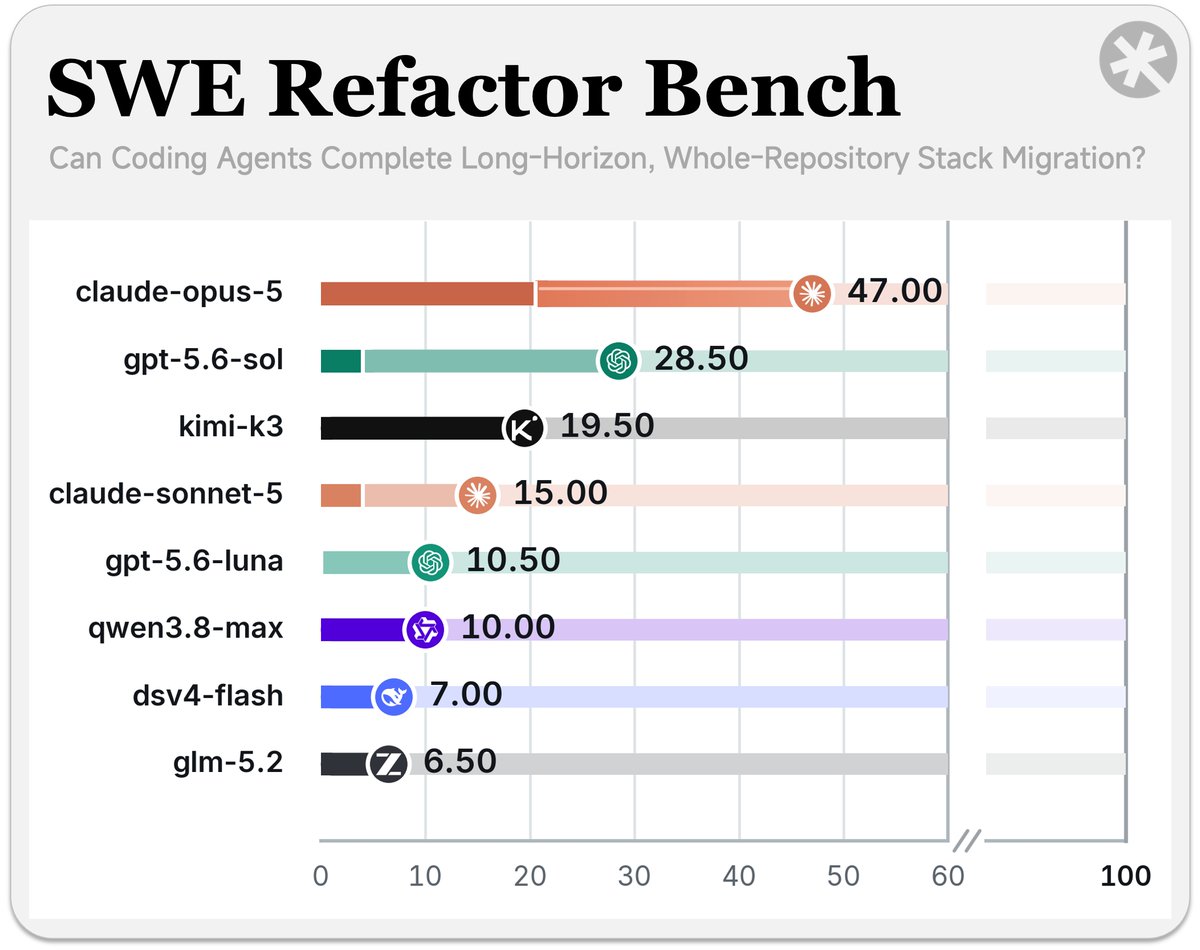
The ultimate test for coding agents isn't local editing— it's whole-repo evolution, and right now, the survival rate is 5.4%. Today we’re releasing SWE Refactor Bench, a benchmark for long-horizon, whole-repository software stack migration. Coding agents are getting very good at fixing bugs. But can they refactor an entire system, C → Rust, Maven → Gradle, POSIX → WebAssembly? We built 20 real migrations across projects, including SQLite, zlib, libsodium, and GraphHopper. 520 runs. Only 28 survived all 3 stages. 13/20 tasks were solved by nobody. System-scale migration is still wide open. Full breakdown 👇 GitHub: [https://t.co/xXyLQ3qq0C] Paper Link: [https://t.co/lO1Enh63q7] Einsia Website: [https://t.co/AGn0hF5gwL]

If you're 17 (or any age) and you want to learn to build LLMs from scratch, read chapters 15-16 of Deep Learning with Python, available online here: https://t.co/Nisfkzf9sC In particular, chapter 15 has one of the best explanations of WHY dot-product attention works that you'll find anywhere.
Today, we're kicking off the first phase of the research preview for Model Hardware Standard (MHS): a new standard for AI agents to safely operate physical equipment in scientific research and advanced manufacturing. Read more: https://t.co/XQ2y9EW7Af https://t.co/kgyCvZ6iYc
If you're looking for a weekend project, how about training your own text-to-speech model from scratch on your own GPU, and then running it on any device's CPU? We just open-sourced the entire Pocket TTS training stack: data pipeline, recipes, and evals. It learns pretty damn fast: ~15k steps: babbling starts turning into words ~50k steps: it reads anything you type (WER under 1%) ~200k steps: the voice stops sounding synthetic On a beefy consumer GPU, that's a week of training. On eight H100s: 10-20 hours. A TTS training run will cost you less than $200 if you rent your hardware, and an order of magnitude less if you just pay for power. Some things we'd love to see people try: - Train it in your own language (a few hundred hours of speech gets you surprisingly far). - Add new features to Pocket TTS (Emotion tags? Make it sing?). - Beat us at our own game: make it faster and smaller. Show us what you build! We'll highlight the best models and new languages for the whole community to enjoy. Pocket TTS has already found many use cases, from reading for people with visual impairments to making NPCs in video games talk, and we're sure there's much more to do with it! Here's an example of a Czech Pocket TTS. Try just asking your favorite agent to find data and apply the method, and you can have your own. Get started: https://t.co/3EH3sbKNRU
I made a video about what happens when you execute `c = a @ b` in PyTorch, from the code to silicon. Hopefully it will help you appreciate that simple line of code more. Made by Grok @bot. Enjoy! https://t.co/hdn0fFSIA8
It's beneficial for a software engineer to learn chip design so they understand how numerics flow through circuitry each cycle.
Introducing our new work, Code World Model—a new world-model paradigm with a language model as its brain. A Coding Agent continuously maintains and updates the world state, which then guides a video model to generate high-fidelity visuals. Two key motivations: 1. Complex world interactions go far beyond motion and collisions. They involve goals, rules, causality, and other high-level semantics—and therefore require the intelligence and reasoning capabilities of language models. 2. Games are a primary data source for video world models, yet game frames are simply the visual outputs of code execution. Directly learning action-to-video mappings asks the video model to bypass code and explicit world states and implicitly approximate program outputs. This is not only inefficient, but also entangles world evolution with visual generation in a single model. Project Page: https://t.co/ypvR2ZAVtV
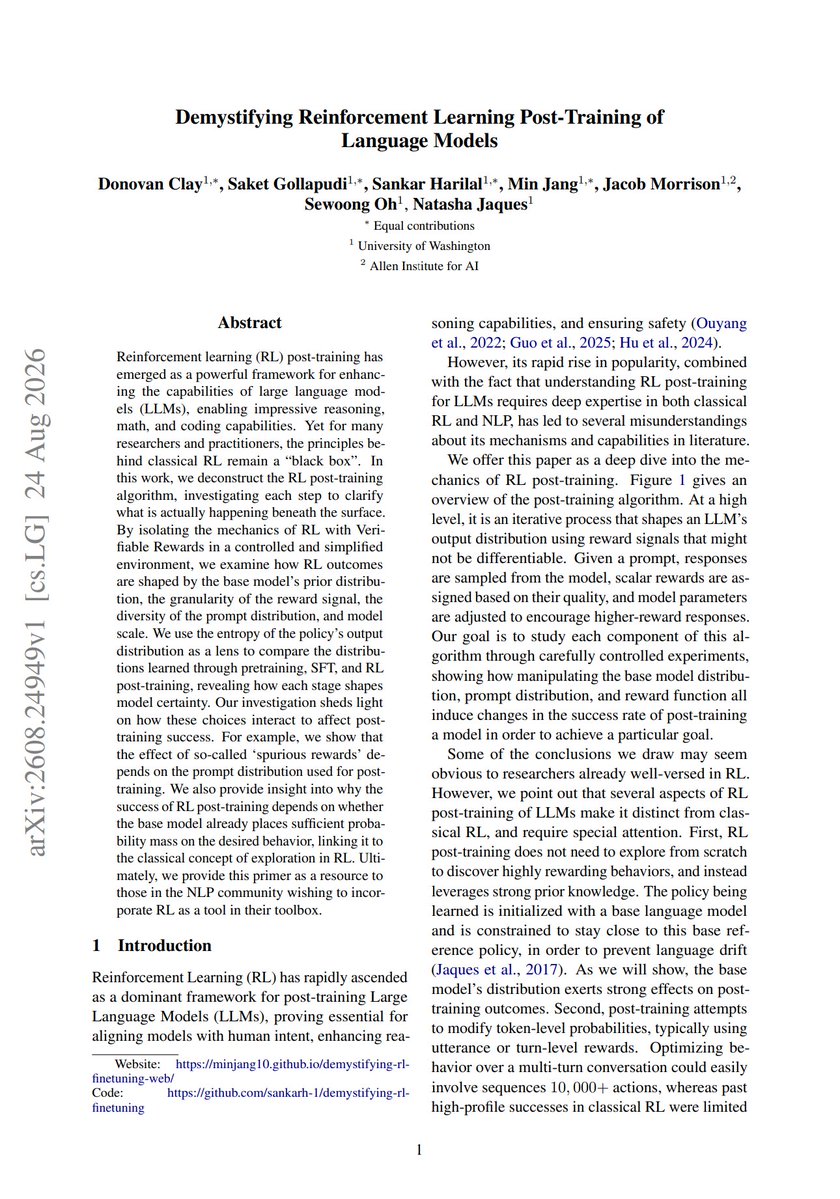
Demystifying Reinforcement Learning Post-Training of Language Models A very useful exploration of RLVR in a simplified setup, lots of good insights... "Result 1: sparse RL cannot find what the model never samples" "Result 2: dense rewards break that ceiling" "Result 3: "spurious rewards" are a story about the prompt set" "Post-training is best understood as redistributing probability mass inside the pretrained distribution. That framing suggests the measurement: track the probability the model assigns to the behavior you want, and track the entropy of its output distribution, throughout training." project page: https://t.co/iPL9jqlxEL code: https://t.co/K9MtdC28Sl link: https://t.co/RQfH9TqfLy
Depth-aware light injection in TypeGPU I got a 448x448 monocular depth model down to ~8 ms on my M4 Pro across ~250 dispatches, which is fast enough to use in realtime :D Since the inference is written directly in TypeGPU, I can just feed the depth buffer straight into the lighting pass. It never has to leave the GPU or go through any extra synchronization/interop step Inference, lighting and draw all go through the same command encoder.
Someone asked what I'd do if I were 17. I'd learn how to build LLMs from scratch, and then train ones as powerful as I could with whatever hardware I could get access to.